

Dryad's Saddle
Cerioporus squamosus
What it is
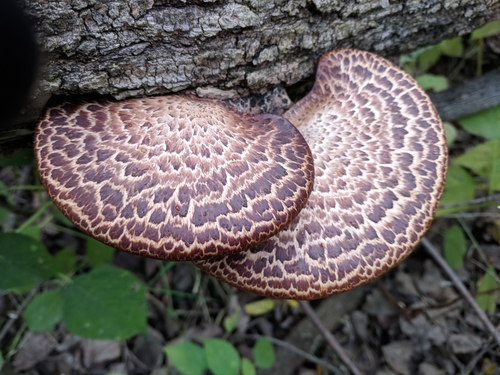
Polyporus squamosus aka Cerioporus squamosus (yet to be confirmed new taxonomy) is a basidiomycete bracket fungus, with common names including dryad's saddle and pheasant's back mushroom. It has a widespread distribution, being found in North America, Australia, Asia, and Europe, where it causes a white rot in the heartwood of living and dead hardwood trees. The name "dryad's saddle" refers to creatures in Greek mythology called dryads who could conceivably fit and ride on this mushroom,...
Where and when to find it
- Habitat
- You can find this fungus on dead or dying hardwood trees, like oak and maple, in forests and parks across the eastern US and parts of the Midwest.
- How to find it
- Look for large, flat, shelf-like mushrooms on tree trunks, especially after rain. They have a scaly top and small holes underneath.
- Best time of day
- Spring through fall, sometimes even in mild winter in warmer areas.
How it lives
- What it eats
- Dead wood from trees.
- What eats it
- Insects, squirrels, and other small animals.
Worth knowing
- It gets its name because dryads (tree nymphs in stories) were thought to ride on them.
- The underside has pores instead of gills, like many mushrooms.
- It's also called 'Pheasant's Back Mushroom' because of its scaly pattern.
- When young, it has a pleasant, cucumber-like smell.
- You might find several growing on the same tree, one above the other.
- It feels quite tough, not soft like many other mushrooms.
Why it matters
Dryad's Saddle helps break down dead wood, returning important nutrients to the soil. This makes the forest healthier.