

Pacific chorus frog
Pseudacris regilla
What it is
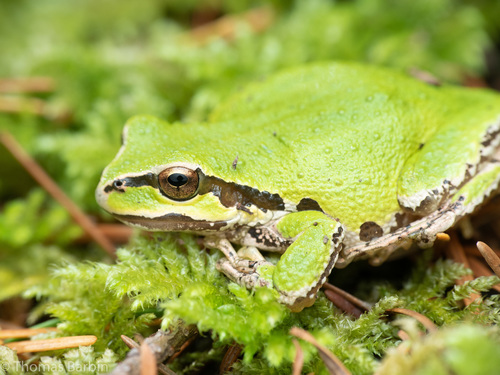
The Pacific tree frog (Pseudacris regilla), also known as the Pacific chorus frog, has a range from the West Coast of the United States (from Northern California, Oregon, and Washington) to British Columbia in Canada and extreme southern Alaska. They live from sea level to more than 10,000 feet in many types of habitats, reproducing in aquatic settings. They occur in shades of greens or browns and can change colors over periods of hours and weeks.
Where and when to find it
- Habitat
- You can find them throughout the western US, often near ponds, streams, marshes, and even puddles.
- How to find it
- Listen for their loud 'rib-bit' call, especially at night or after rain. Look for them hiding in grass or under leaves near water.
- Best time of day
- Spring and winter evenings, especially after rain, is when their calls are loudest.
How it lives
- What it eats
- Mosquitoes, flies, beetles, spiders
- What eats it
- Snakes, birds, raccoons, larger frogs, fish
Worth knowing
- They are also called Pacific Tree Frogs.
- Their sticky tongues help them catch insects super fast.
- They can live for about 5 to 7 years in the wild.
- Even though they are called 'tree frogs,' they spend a lot of time on the ground too.
- Their calls can be heard from far away, even though they are only about 2 inches long!
- Sometimes they look bright green, other times they are brown or gray.
Why it matters
Pacific Chorus Frogs are an important food source for many animals and help control insect populations.