

Ailanthus Webworm Moth
Atteva aurea
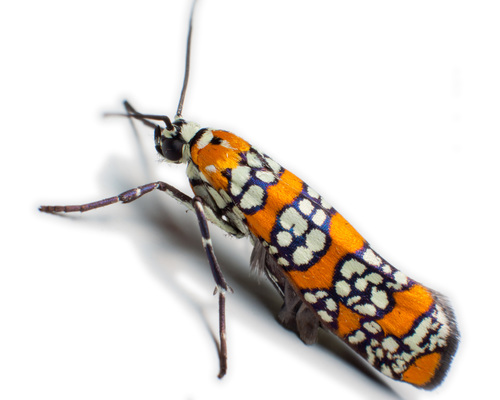
What it is
The ailanthus webworm (Atteva aurea) is an ermine moth now found commonly in the United States. It was formerly known under the scientific name Atteva punctella (see Taxonomy section). This small, very colorful moth resembles a true bug or beetle when not in flight, but in flight it resembles a wasp.
Where and when to find it
- Habitat
- Found across much of the United States where its host plant, the Ailanthus tree (Tree of Heaven), grows. This tree is common in urban areas and disturbed sites.
- How to find it
- Look for their silken webs on the leaves of Ailanthus trees (Tree of Heaven). The adult moths are active during the day and are quite striking.
- Best time of day
- Daytime for adults, summer and fall for webs.
How it lives
- What it eats
- Leaves of the Ailanthus tree (Tree of Heaven) as caterpillars. Adults do not eat.
- What eats it
- Birds, bats, spiders, predatory insects.
Worth knowing
- The caterpillars live together in a silk web they weave on the tree.
- The adult moths are active during the day, which is unusual for most moths.
- They have a wingspan of about an inch, making them quite small.
- Their bright colors might be a warning to birds that they don't taste good.
- The 'Tree of Heaven' was brought to the US from Asia a long time ago.
- They are sometimes confused with butterflies because they fly during the day.
Why it matters
Ailanthus Webworm Moths are a food source for birds and larger insects. They are tied to a specific tree that is not native to the US.