

Gopher Snake
Pituophis catenifer
What it is
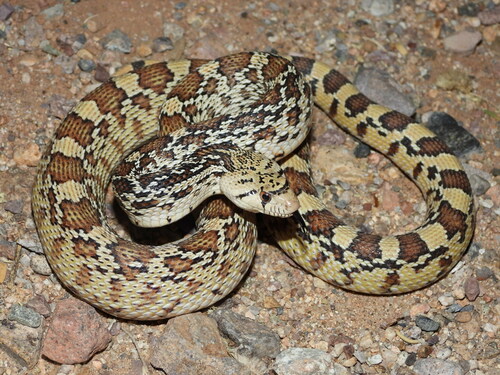
Pituophis catenifer is a species of nonvenomous colubrid snake endemic to North America. Nine subspecies are currently recognized, including the nominotypical subspecies, Pituophis catenifer catenifer, described here. This snake is often mistaken for the prairie rattlesnake, but can be easily distinguished from a rattlesnake by the lack of black and white banding on its tail and by the shape of its head, which is narrower than a rattlesnake's.
Where and when to find it
- Habitat
- Widespread across the western and central United States, found in grasslands, deserts, woodlands, and agricultural areas.
- How to find it
- Look for them in open fields, rocky areas, or along trails. They might be basking in the sun or crossing roads. They are good at hiding!
- Best time of day
- Warm, sunny days, especially spring through fall. Most active during the day.
How it lives
- What it eats
- Rodents like gophers and mice, birds, lizards, and eggs.
- What eats it
- Hawks, owls, coyotes, bobcats, and other snakes.
Worth knowing
- When threatened, they often hiss loudly and vibrate their tail, making a sound like a rattlesnake.
- Gopher snakes are not venomous; they constrict their prey to eat it.
- They are excellent burrowers and spend a lot of time underground.
- They can grow quite long, sometimes over 6 feet!
- Their scales are often patterned with dark blotches on a lighter background.
- Farmers often welcome gopher snakes because they help protect crops from rodents.
Why it matters
Gopher snakes are natural pest controllers, eating rodents that can harm crops. They are a key part of their ecosystem's food chain.