

Mediterranean House Gecko
Hemidactylus turcicus
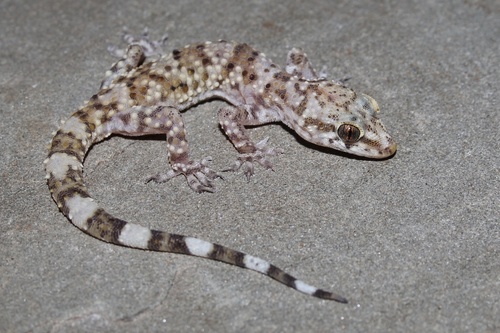
What it is
The Mediterranean house gecko (Hemidactylus turcicus) (not to be confused with the Asian species Hemidactylus frenatus known as common house gecko) is a small gecko common to the Mediterranean which has spread to many parts of the world. It is commonly referred to as the Turkish gecko as represented in its Latin name and also as the "Moon Lizard" because it emerges in the evening. A study in Portugal found H. turcicus to be totally nocturnal,...
Where and when to find it
- Habitat
- Found mostly in the southeastern United States, especially in and around buildings and urban areas. They like warm places.
- How to find it
- Look on walls, fences, and under outdoor lights at night. Their eyes often glow red in a flashlight beam.
- Best time of day
- Nighttime, especially warm evenings.
How it lives
- What it eats
- Small insects like moths, crickets, and spiders.
- What eats it
- Cats, birds, snakes, and larger lizards.
Worth knowing
- They can change their skin color to match their surroundings.
- They are not native to the US but have made themselves at home here.
- Their tail can break off and wiggle to distract predators, then grow back later.
- They make soft chirping sounds.
- Their pupils are vertical slits, good for seeing in the dark.
- They are harmless to humans.
Why it matters
Mediterranean house geckos help control insect populations in and around homes. They are a food source for larger animals.