

Black Vulture
Coragyps atratus
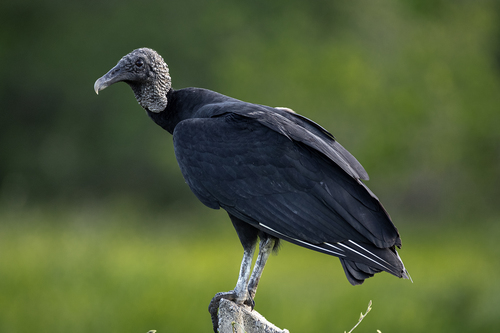
What it is
The black vulture (Coragyps atratus), also known as the American black vulture, is a bird in the New World vulture family whose range extends from the southeastern United States to Peru, Central Chile and Uruguay in South America. Although a common and widespread species, it has a somewhat more restricted distribution than its compatriot, the turkey vulture, which breeds well into Canada and south to Tierra del Fuego. It is the only extant member of the
Where and when to find it
- Habitat
- You can find Black Vultures in open country, forests, and suburban areas across the southeastern and south-central United States.
- How to find it
- Look up in the sky for their distinctive soaring pattern: they often hold their wings in a 'V' shape and wobble a bit. Their wingtips are silvery-white underneath. In groups, they can be seen near roadsides or perched in tall trees.
- Best time of day
- Daytime, especially when the sun is out and thermals are strong.
How it lives
- What it eats
- Mostly dead animals (carrion).
- What eats it
- Larger raptors (rarely), bobcats (if they can catch them).
Worth knowing
- Black Vultures have very strong stomach acid that helps them digest rotten meat safely.
- They often roost together in large groups in tall trees or on power lines.
- Unlike Turkey Vultures, Black Vultures have a poor sense of smell and rely more on sight and other vultures to find food.
- Baby vultures are called 'chicks' and have fluffy white down.
- They can fly for hours without flapping their wings, just by riding air currents.
- Sometimes, they will follow other vultures or even coyotes to find food.
Why it matters
Black Vultures are incredible at cleaning up dead animals, which helps prevent the spread of diseases. They play a vital role in keeping our environment healthy.