

Double-crested Cormorant
Nannopterum auritum
What it is
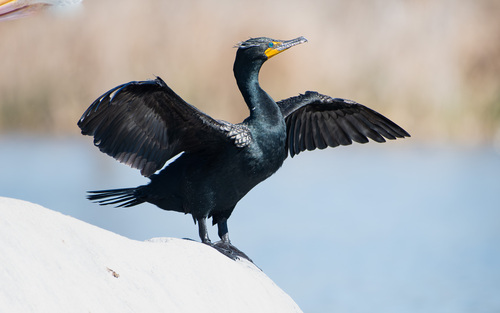
The double-crested cormorant (Nannopterum auritum) is a member of the cormorant family of water birds. It is found near rivers and lakes, and in coastal areas, and is widely distributed across North America, from the Aleutian Islands in Alaska down to Florida and Mexico. Measuring 70–90 cm (28–35 in) in length, it is entirely black except for a bare patch of orange-yellow facial skin and some extra plumage that it exhibits in the breeding season, when it grows...
Where and when to find it
- Habitat
- You can find them all over the US, near any body of water, including coastlines, rivers, lakes, and ponds.
- How to find it
- Look for them swimming low in the water, sometimes diving completely under. You'll often see them perched on docks, buoys, or dead trees with their wings outstretched.
- Best time of day
- Daytime, especially morning and late afternoon when they are actively fishing or drying wings. Active year-round in many areas.
How it lives
- What it eats
- Mostly fish, but also sometimes crustaceans, and amphibians.
- What eats it
- Bald eagles, gulls (eggs/chicks), raccoons (eggs/chicks), and sometimes sharks.
Worth knowing
- Their feathers are not completely waterproof, which is why they often spread their wings to dry.
- The 'double crest' is a small tuft of feathers behind each eye that is only visible during breeding season.
- They have dark blue eyes that look almost green up close.
- Cormorants have a special gland that helps them remove salt from saltwater.
- They can dive to depths of 20-30 feet or more to catch fish.
- A group of cormorants is sometimes called a 'gulp' or a 'swim'.
Why it matters
Double-crested Cormorants are important fish eaters in aquatic ecosystems. They are also food for larger predators.