

Great-tailed Grackle
Quiscalus mexicanus
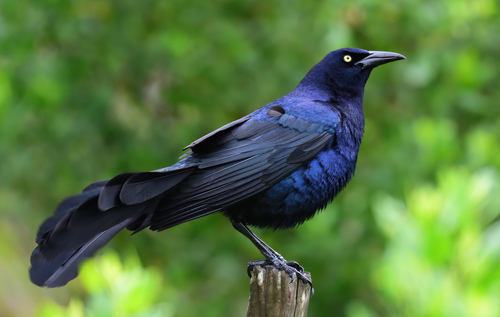
What it is
The great-tailed grackle or Mexican grackle (Quiscalus mexicanus) is a medium-sized, highly social passerine bird native to North and South America. A member of the family Icteridae, it is one of 10 extant species of grackle and is closely related to the boat-tailed grackle and the extinct slender-billed grackle. In the southern and southwestern United States, the grackle is sometimes referred to simply as a "blackbird" or (erroneously) a "crow" due to its glossy black plumage;
Where and when to find it
- Habitat
- Common in open areas, towns, and cities across the western and southern United States, especially near water.
- How to find it
- Look for them in parking lots, parks, and fields, often walking on the ground. Listen for their varied, sometimes harsh calls.
- Best time of day
- All day, year-round.
How it lives
- What it eats
- Insects, seeds, fruits, human scraps
- What eats it
- Hawks, owls, snakes, cats
Worth knowing
- Males have a spectacular long, V-shaped tail.
- They can be very noisy, especially when gathering in large groups.
- They are very intelligent and can solve simple puzzles.
- They sometimes 'ant' themselves by letting ants crawl on their feathers, which may help with parasites.
- Their eyes are bright yellow.
- Females are smaller and duller than males, with shorter tails.
Why it matters
Great-tailed Grackles help control insect populations and disperse seeds. Their loud calls add to the sounds of many communities.