

Northern Shoveler
Spatula clypeata
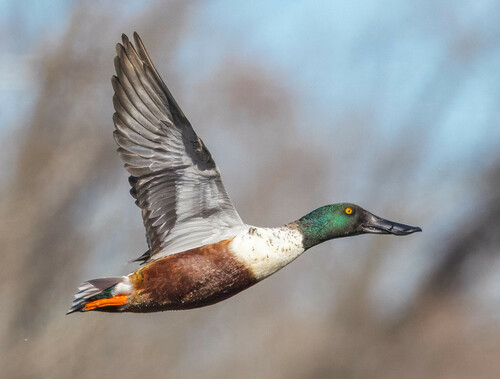
What it is
The northern shoveler (/ˈʃʌvələr/; Spatula clypeata), or northern shoveller in British English, sometimes known simply as the shoveler, is a common and widespread duck. It breeds in northern areas of Europe and Asia and across most of North America, wintering in southern Europe, Africa, the Indian subcontinent, Southeast Asia, and Central, and northern South America. It is a rare vagrant to Australia. In North America, it breeds along the southern edge of Hudson Bay and west...
Where and when to find it
- Habitat
- You can find Northern Shovelers in shallow wetlands, marshes, and ponds across most of the United States, especially during migration and winter.
- How to find it
- Look for a duck with a very long, wide, spoon-shaped bill. Males are very colorful with a dark green head, white chest, chestnut sides, and blue wing patches. Females are mottled brown.
- Best time of day
- Daytime, during fall and spring migration or in wintering areas.
How it lives
- What it eats
- Small aquatic insects, crustaceans, seeds, tiny plants.
- What eats it
- Hawks, owls, raccoons, skunks, foxes.
Worth knowing
- Their unique bill has special comb-like structures called lamellae for filtering food.
- They often swim with their heads partly submerged, sifting through the water.
- Northern Shovelers are dabbling ducks, meaning they tip their tails up to feed rather than diving fully underwater.
- The male's bright colors are only seen during breeding season.
- They gather in larger flocks during migration and winter.
- Their bills are perfectly designed to catch even the tiniest aquatic creatures.
Why it matters
Northern Shovelers filter tiny plants and animals from the water, helping to clean the water. They are also a food source for some wetland predators.