

Amur honeysuckle
Lonicera maackii
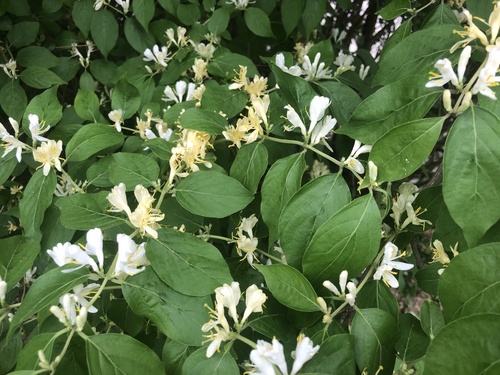
What it is
Lonicera maackii, the Amur honeysuckle, is a species of honeysuckle in the family Caprifoliaceae that is native to temperate western Asia, specifically in northern and western China south to Yunnan, Mongolia, Primorsky Krai in southeastern Russia, Korea, and, albeit rare there, central and northern Honshū, Japan.
Where and when to find it
- Habitat
- You can find Amur honeysuckle in many places across the eastern and central US, often in woods, forest edges, and open fields.
- How to find it
- Look for tall, multi-stemmed bushes with oval leaves that stay green late into fall. In late summer/fall, it has bright red berries.
- Best time of day
- Year-round, but especially in late fall when its green leaves stand out among bare trees, and its red berries are visible.
How it lives
- What it eats
- Sunlight, water, nutrients from soil
- What eats it
- Some birds eat its berries, but they are not very nutritious for them.
Worth knowing
- It was brought to the US from Asia a long time ago for gardens and to help control soil erosion.
- Birds eat its berries and then spread its seeds to new places.
- It can grow so thick that it stops young trees from growing.
- Even though it has pretty flowers and berries, it can be a problem in natural areas.
- Its hollow stems can be a clue to tell it apart from native honeysuckles.
- It can grow to be over 15 feet tall!
Why it matters
Amur honeysuckle grows very quickly and can take over spaces needed by native plants.