

Virginia creeper
Parthenocissus quinquefolia
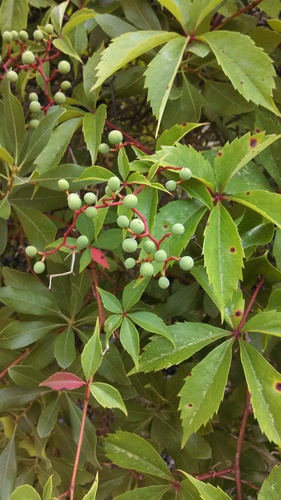
What it is
Parthenocissus quinquefolia, known as Virginia creeper, Victoria creeper, five-leaved ivy, or five-finger, is a species of flowering plant in the grape family, Vitaceae. It is native to eastern and central North America, from southeastern Canada and the eastern United States west to Manitoba and Utah, and south to eastern Mexico and Guatemala.
Where and when to find it
- Habitat
- Commonly found in forests, fields, and along roadsides throughout most of the eastern and central US.
- How to find it
- Look for a climbing vine with five leaves together, like fingers on a hand. It often turns bright red in the fall.
- Best time of day
- Year-round; bright red leaves are best seen in autumn.
How it lives
- What it eats
- It makes its own food from sunlight (photosynthesis)
- What eats it
- Birds (the berries), deer (the leaves)
Worth knowing
- It has five leaflets, which helps tell it apart from poison ivy, which has three.
- The small, dark blue berries are a favorite food for many bird species.
- It uses tiny suction-cup like discs to attach itself to surfaces as it climbs.
- Despite its name, it's not a true creeper but a climbing vine.
- The fall color can be truly spectacular, ranging from orange to deep crimson.
- It can grow very quickly and cover large areas.
Why it matters
Virginia Creeper provides food and shelter for birds and insects. It also creates ground cover, which helps prevent soil erosion.