

Carolina horsenettle
Solanum carolinense
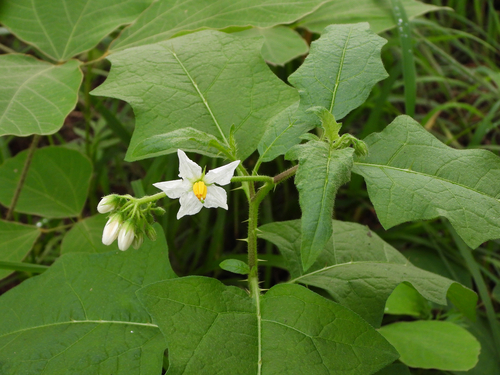
What it is
Solanum carolinense, the Carolina horsenettle, is not a true nettle, but a member of the Solanaceae, or nightshade family. It is a perennial herbaceous plant, native to the southeastern United States that has spread widely throughout much of temperate North America. It has also been found in parts of Europe, Asia, and Australia. The stem and undersides of larger leaf veins are covered with spines.
Where and when to find it
- Habitat
- You can find Carolina Horsenettle in disturbed areas, fields, pastures, roadsides, and open woods across most of the eastern and central United States.
- How to find it
- Look in sunny, open areas, especially where the ground has been disturbed. Identify it by its spiny stems and leaves, and its five-petaled, star-shaped flowers.
- Best time of day
- Blooms from late spring to late summer (May-September). Look during the day.
How it lives
- What it eats
- Makes its own food using sunlight (photosynthesis).
- What eats it
- Some insect larvae (e.g., potato beetle), a few bird species eat berries.
Worth knowing
- It is a member of the nightshade family, like tomatoes and potatoes.
- The yellow berries are considered poisonous to humans and livestock if eaten.
- It has sharp prickles on its stems and the underside of its leaves.
- The flowers of this plant are often visited by bumblebees.
- Despite its name, it's not a true nettle, which is a different plant family.
- Some butterflies lay their eggs on it.
Why it matters
Carolina Horsenettle provides food for some insect larvae, including certain moths. Its berries are eaten by a few bird species.