

ground-ivy
Glechoma hederacea
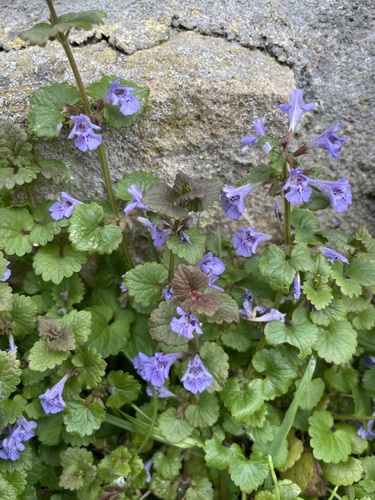
What it is
Glechoma hederacea (syn. Nepeta glechoma Benth., Nepeta hederacea (L.) Trevir.) is an aromatic, perennial, evergreen creeper of the mint family Lamiaceae. It is commonly known as ground-ivy, gill-over-the-ground, creeping charlie, alehoof, tunhoof, catsfoot, field balm, and run-away-robin. It is also sometimes known as creeping jenny, but that name more commonly refers to Lysimachia nummularia. It has numerous medicinal uses, and is used as a salad green in many countries. European settlers carried it around the world,...
Where and when to find it
- Habitat
- You can find ground-ivy in many places across the US, especially in yards, gardens, and woodlands.
- How to find it
- Look for it in shady or partly shady areas. It often grows in lawns or a bit wilder spots. It has a square stem!
- Best time of day
- Spring and summer, especially when its small purple flowers are blooming.
How it lives
- What it eats
- Sunlight, water, and nutrients from soil
- What eats it
- Some insects and deer may nibble on it
Worth knowing
- It's a member of the mint family, even though it doesn't always smell minty.
- Sometimes people call it "Creeping Charlie."
- Its stems can root wherever they touch the ground, helping it spread.
- The leaves have a slightly crinkled or rounded-scalloped edge.
- Its tiny purple flowers are like little trumpets for small bees.
- It can grow in many different kinds of soil.
Why it matters
Ground-ivy spreads easily, covering bare ground and helping to hold soil in place. It can be an early food source for some insects.