

striped wintergreen
Chimaphila maculata
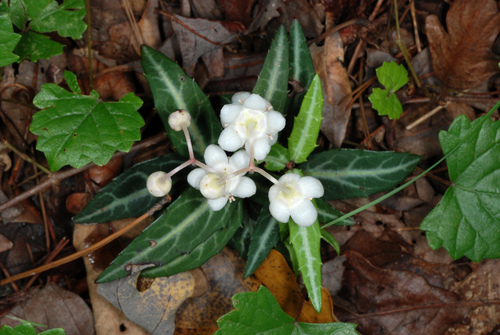
What it is
Chimaphila maculata (spotted wintergreen, also called striped wintergreen, striped prince's pine, spotted pipsissewa, ratsbane, or rheumatism root) is a small (10–25 cm tall), perennial evergreen herb native to eastern North America and Central America, from southern Quebec west to Illinois, and south to Florida and Panama.
Where and when to find it
- Habitat
- You can find striped wintergreen in woodlands and forests across the eastern and central United States.
- How to find it
- Search for it under trees in shady spots. Its leaves are easy to spot with their distinctive white veins forming a stripe pattern. Small bell-shaped flowers appear in summer.
- Best time of day
- Year-round, as its leaves are evergreen. Flowers bloom in summer.
How it lives
- What it eats
- Makes its own food using sunlight (photosynthesis).
- What eats it
- Some insects, deer (infrequently).
Worth knowing
- It is an evergreen plant, meaning its leaves stay green all winter long.
- It has small, waxy leaves that help it survive cold weather.
- The flowers of striped wintergreen hang upside down like tiny bells.
- Sometimes called 'pipsissewa,' an old Native American name.
- Its leaves have a mild, spicy taste if you chew them carefully (don't eat plants you are unsure of!).
- It grows very slowly, making it a precious find in the forest.
Why it matters
This evergreen plant adds beauty to the forest floor and provides cover for small creatures. It contributes to the biodiversity of healthy forests.