

wild carrot
Daucus carota
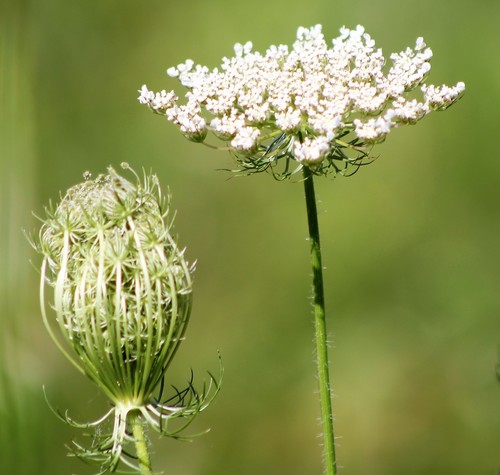
What it is
Daucus carota, whose common names include wild carrot, bird's nest, bishop's lace, and Queen Anne's lace (North America), is a white, flowering plant in the family Apiaceae, native to temperate regions of Europe and southwest Asia, and naturalized to North America and Australia.
Where and when to find it
- Habitat
- You can find wild carrot almost everywhere in the US in open, sunny places like fields, roadsides, and meadows.
- How to find it
- Look for its large, flat-topped clusters of tiny white flowers. The leaves are feathery, a bit like carrot tops. Crush a leaf for a carrot smell!
- Best time of day
- Summer and fall when its flowers are blooming.
How it lives
- What it eats
- Sunlight, water, and nutrients from soil
- What eats it
- Some insects (nectar), rabbit (leaves), small mammals (seeds)
Worth knowing
- It is the wild ancestor of the carrots we eat!
- After the flowers bloom, the white flower head curves inward to look like a bird's nest.
- The tiny dark spot in the middle of some flower clusters is thought to attract insects.
- Another name for it is Queen Anne's Lace.
- Its roots are white and smell like carrots, but they are tough.
- Many small insects use its flat flower clusters as a landing pad.
Why it matters
Wild carrot is a food source for some insects and helps enrich the soil when it dies back. It supports pollinators.